The screech woke him… A sharp, grinding sound of tires on asphalt that bored into his throbbing skull. The world inside his head was spinning, and he felt the speeding metal cage in which he was locked lurching violently from side to side, trying to force its way through the gridlocked traffic of the Bristol metropolis.
Slowly, with great effort, he cracked his eyelids open. The image was blurred and indistinct. His eyes caught white silhouettes leaning over him—people in lab coats. Their movements, honed by years of training, were steady, fast, and precise.
“Please don’t move. Breathe steadily,” the paramedic’s voice sounded metallic, as if coming from behind thick glass. A British accent, hard and practical. He tried to say something, to ask what had happened, but a hand in a rubber glove proved faster. A plastic mask suddenly covered his face. A valve hissed. A cool, dry stream of oxygen hit his lungs, stifling his cry in its infancy. The ambulance jolted again, and darkness became his home once more.
Suddenly, the pain subsided. He felt a lightness and a strange peace he hadn’t known since childhood. The wail of the sirens faded, becoming distant, almost inaudible. He felt as if he were floating and spinning gently at the same time. He felt no fear, only wonder. He looked down. Inside the cramped interior of the vehicle lay a man. Gray, broken, with a tube in his mouth. He realized it was him…
Then the images flooded in. Not a chaotic film of his entire life, but only what held his soul to the earth like an anchor embedded in the seabed. Sara, sweet little Sara, now a woman nearly thirty years old. His daughter. The sense of fear he carried within him like a stone became transparent here. Those monthly transfers… “a few pennies,” as he called them, were merely a shield. A shield against loneliness and oblivion. He was afraid that without the money, he would become invisible and useless to her. And that she would quickly forget him…
And Lili. His granddaughter. The image from WhatsApp hung in his consciousness. Tiny hands, a pixelated smile. He had never smelled her scent. He had never touched her hair. He was just a voice from a speaker to her. Please, I don’t want to go!—his soul wailed silently. —I haven’t met her yet!
Below, in the metal tin of the ambulance, hell broke loose. “We’re losing him! V-fib!” the paramedic screamed, his voice, full of panic, piercing the barrier of peace. “Charge to two hundred! Stand back!” The body on the stretcher arched in an unnatural curve under the massive jolt of energy. He felt that yank even there, above. As if an invisible rope, tied to his soul, had suddenly snapped taut, trying to pull him back into the mud of existence.
And then, in that fractional silence between heartbeats, he heard it. A voice warm, calm, smelling of tobacco and old wood. A voice that was the very definition of safety. “It’s not your time, Little Artur,” Grandpa said. He didn’t see him, but he felt his presence, powerful and protective, right beside him. “Not yet. You still have something to do. Go back.”
The light went out, giving way to an endless, velvety blackness. Suddenly, he felt a violent magnetic jerk that tore him from his state of bliss and silence. The return was not gentle; it was a traumatic collision with matter. He felt energy rushing in streams into every scrap of his body, spreading from his abdomen and chest to his very fingertips. It was accompanied by an intense, almost painful tingling, as if millions of tiny needles were being driven under his skin. Gravity crushed him onto the bed with a force he had never felt before, and his body suddenly seemed cold, slimy, and foreign. A strange sound like the buzzing of insects hummed in his ears, creating rattling vibrations that gradually faded. Chaos pulsed in his head. Hundreds of images flashed under his eyelids at a frantic pace, but suddenly everything began to slow down, finally stopping on one clear memory…
A morning in Bristol. He smelled wet concrete and the mud of a new construction site. As always, he sat in the forklift, taking a calm drag of a cigarette. In front of him stood a truck loaded to the brim with pallets of bricks. The driver, a middle-aged man in a high-vis vest, watched him anxiously as he maneuvered the lift. “Are you new here?” he asked. He answered calmly: “Yes, I just started working here.” “And have you been driving long?” The driver wouldn’t let it go; he was inquisitive. Artur bared his teeth. His favorite moment. “Well, I told you I just started, it’s my first day!” he tossed out, and seeing the driver turn pale, he added with a cackle: “On this site, anyway!”
He always did that. Joking, acting the happy-go-lucky type. It was his mask, tested and airtight. He preferred them to take him for a cheerful fool than for anyone to look deeper. So that no one would notice that damn, burning longing that smoldered in his heart instead of lunch. He looked at the load. The forks needed adjusting to fit the pallets. He pulled the handbrake. It was supposed to be a routine move: hop out, kick the steel arm to the left, hop back in, unload. He had done it thousands of times. He stepped out onto the muddy ground. He leaned over the steel.
He didn’t even hear the whistle. Maybe someone shouted, but the roar of the diesel engine effectively drowned out the warning. A steel scaffolding pipe, which had slipped from someone’s hands three floors up, fell like a spear. Impact. The pipe hit the back of his head and back with full force. A blunt, paralyzing crack that stole his breath. The helmet split like an eggshell, the light went out…
He woke up in sterile whiteness. The pain he felt now was different—dull, muffled by drugs, pulsing rhythmically under his skull and in his shoulder. He tasted metal and disinfectant in his mouth.
A doctor stood by the bed. He had tired eyes, hair slightly dusted with gray, and held a tablet in his hand. He looked at him with the kind of gaze no one wants to see in a medic—there was professional composure, but it was underlined by something heavy.
“Mr. Artur,” he began as soon as he noticed the patient had regained consciousness. His voice was calm and measured. “I have two pieces of news for you: good and bad. Let’s start with the good.” Artur tried to nod, but his neck was stiff as concrete. He only blinked. “You’re alive,” the doctor said bluntly. “You have a severe concussion and a broken collarbone. It will hurt for several weeks, and you’ll need rehabilitation, but you’ll pull through. The bones will heal. There is no permanent spinal damage.”
The doctor paused, then added a bit more warmly: “We also contacted the person listed to be notified in case of an emergency. Your daughter is already on her way to the hospital.” Artur’s heart beat faster. Sara. She was coming here. So he wasn’t indifferent to her after all. For a moment, he felt a relief so deep he almost forgot the pain. But the doctor didn’t leave. He stood in place, nervously tapping his finger on the tablet casing. The atmosphere in the room thickened.
“And the bad news?” he croaked. His voice was weak, as if unused for years. The doctor sighed, moving closer to the bed. “Standard procedure for head injuries is a CT scan. We had to check for hematomas or brain swelling after the impact,” he explained slowly, weighing every word. “There is no hematoma, Mr. Artur. But the scan unfortunately showed something else.”
He felt a cold shiver run over him. “What else?” he asked. “You have a tumor in the frontal lobe,” the doctor said quietly but firmly, pointing to a dark spot on the tablet screen. “It’s large. And unfortunately, from what we see on the image, it looks like a glioma. I’m sorry. Paradoxically, the accident gave us a chance to detect it before you simply collapsed and didn’t get up again.”
“How much time do I have?” Artur rasped. The words scraped his throat like gravel, but he had to know. Specifically. Like on a construction site—the deadline. The doctor sighed heavily and leaned back in his chair, clasping his hands. “That’s hard to determine precisely, Mr. Artur. Medicine isn’t mathematics; here, two plus two rarely equals four. The tumor is aggressive.” The medic hesitated, then threw the numbers on the table like cards in poker. “Maybe a year. Maybe a few months. The cancer will progress. Memory problems, speech issues, personality changes may occur… Theoretically, we could try surgery, but it’s very risky.”
The silence that fell in the room was heavier than a ton of bricks Artur had been loading that morning. A year, or a risky gamble for everything. The medic cleared his throat, breaking the silence. His face now expressed something more than just professional sympathy—there was genuine bewilderment on it. “And one more thing,” he continued, narrowing his eyes and staring at the charts on the tablet. “We don’t fully understand what happened in the ambulance.” Artur raised an eyebrow, ignoring the pain the movement caused in the back of his head. “Yes, you have a broken collarbone and a severe head injury,” the doctor continued, weighing his words. “But from a medical standpoint, these are not injuries to a degree that directly threatens life. They should not have led to sudden cardiac arrest.” The doctor shook his head as if arguing with himself. “We did further scans, looked for an embolism, hidden hemorrhage, anything that would explain the incident. But we found nothing else. Your heart simply stopped. And then, suddenly and against logic, it started again. It was as if you simply… stepped out and came back.”
Artur clenched his hand on the coarse sheet. He knew. He knew it wasn’t medicine. It was a return ticket he had received on credit. The doctor left, leaving behind a heavy silence, broken only by the rhythmic beeping of the monitor. Exhaustion, heavier than lead, pulled his eyelids down. He fell asleep, but it was not a soothing sleep. It was a collapse into a restless abyss where thoughts swirled like clouds before a storm.
Paradoxically, in this chaos, there was no room for fear for himself. Cancer? A tumor the size of a fist? Those were just technical details, a machine failure. Something else mattered now. Something that pulsed in him more strongly than the pain. Sara. The desire to be needed burned like a living fire. He wanted to be a father, not an ATM. And Lili. He must see her. That was the goal. The final task for which he had returned from the other side.
He was dozing, lulled by a chemical sleep, when a shiver suddenly pierced him. Instinct told him to open his eyes. He felt a presence. Sara was sitting in the chair next to him. She was looking at him, but there was no pity in that gaze, which he had feared. There was love. Pure, unconditional. “I know everything, Dad,” she said quietly.
He felt his throat tighten. Shame burned more than the broken collarbone. “I’m sorry…” he rasped, avoiding her eyes. “I won’t be able to send anything more. It’s over. I don’t have the strength for this job anymore.” He caught his breath, gathering his courage. “Just let me see my granddaughter. Just once.”
Sara leaned over him. Tears glistened in her eyes, but her smile was warm and ironic at the same time. “You old fool,” she whispered, taking his worn hand. “Do you think I talk to you because you send me money? That your presence has a price tag?” He looked at her, shocked. “I only allowed it so you would feel needed,” she continued. “But we haven’t spent a penny of it. I put it all aside in a special account. For Lili. I want you to come to us. Not as an ATM. As a grandfather.”
He looked at Sara and felt the last dam break inside him. Emotion robbed him of speech. Suddenly, however, the image changed. The contours of her face began to ripple, as if he were watching her through a pane of hot air rising above a radiator. A strange mist began to form around her head—first, he noticed a narrow band of blue-gray glow right against the skin, resembling a dense, sparkling web of light. With her every breath, this glow pulsed, and the blue layer began to interweave with an outer coating of shimmering, pale gold. It looked as if Sara were enclosed in an exquisite cocoon woven from thousands of golden threads that trembled and vibrated with an incredible frequency. He blinked violently, trying to shake off the illusion. It’s starting already, he thought with bitterness and fear. No miracles here. It’s that damn tumor. My own brain is starting to play tricks on me.
Only a few weeks passed, merging into one long string of packing, headaches, and difficult conversations. Sara tried to convince him. She begged, she cried, urging him to have the risky surgery. But he consistently, with the stubbornness of a mule, refused. He didn’t want to spend the rest of his life hooked up to tubes like a vegetable… and he felt he had something else to do. He chose time. He chose being himself, even if that time was to end any moment.
The day of return arrived. The flight to Kraków was an ordeal—the pressure changes made his skull feel like it was splitting, but he grit his teeth so as not to worry his daughter. Then there was a short car journey to a small town outside the city where her house stood. They arrived just in time. Balloons hung in the garden, and a delicious cake with four candles sat on the table; it was Lili’s fourth birthday.
He got out of the taxi, straightening his aching bones. He took a deep breath, smelling the Polish autumn—burning leaves and damp earth. And then he saw her. A little girl in a polka-dot dress. She suddenly ran out of the house with a joyful smile. He froze mid-step. What he saw made his heart stop and his legs buckle under him.
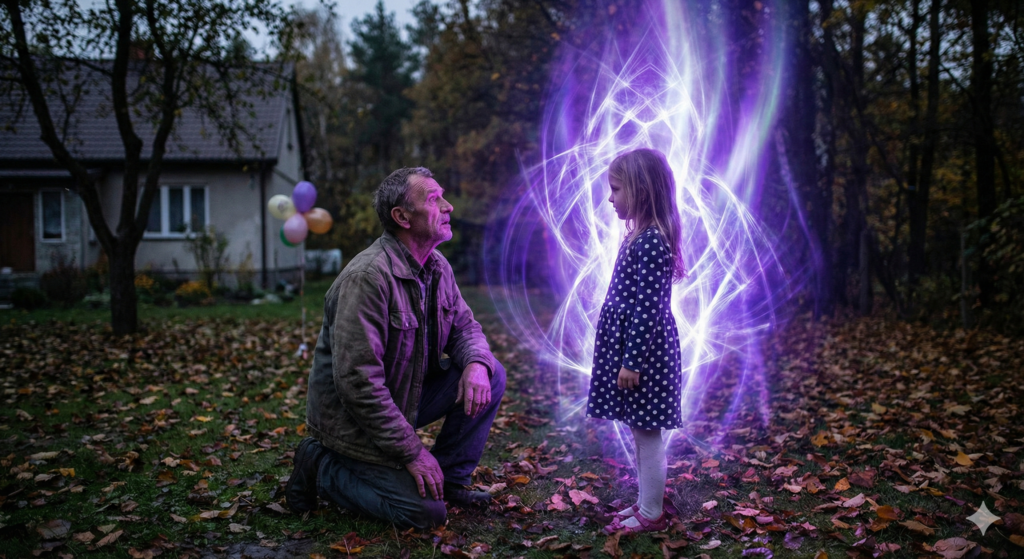
If Sara’s aura was an intricate web, then what surrounded Lili was an elemental force. Around the child’s small body, there was no mist, but a powerful, vibrating, brilliant pillar of light. However, there was neither blue nor gold. Instead, a deep, royal purple dominated—a color incredibly intense, almost black, turning at the edges into a blinding, crystalline white.
The light was not static. It rippled and looked as if it were burning, like a crown of aurora borealis that shot up for meters, waving and changing shapes into complex, beautiful geometric patterns that his mind could not name.
Lili stopped abruptly. Her large, dark eyes found him in a fraction of a second, bypassing Sara and everything else. He looked into those eyes and time ceased to exist. It was not the gaze of a four-year-old. There was no childish shyness or curiosity in it. There was depth. An infinite, calm well of wisdom. Suddenly, a strange feeling pierced him—so strong it took his breath away. It wasn’t the feeling of meeting someone new. It was a remembering. He felt as if he had known this being forever. As if they had already met thousands of times, in other places, in other bodies, and now, after a long separation, their paths had crossed again.
Welcome, old friend—the thought appeared in his head, but he wasn’t sure if it belonged to him.
She ran to him, her little legs moving quickly, her polka-dot dress fluttering in the wind. She smiled radiantly, the smile of an innocent, carefree child seeing someone close. She reached out her arms as if to embrace him in welcome. But the words that flowed from those small, lovely lips made his blood run cold. They were spoken lightly, almost sing-song, yet at the same time, one could feel an incredible strength and confidence in them. “I remember you!” she cried joyfully, grabbing his pant leg. She looked up, and her purple aura rippled violently, slightly blinding him with a glow no one else saw. “You were my student!”
He froze mid-step, unable to make a sound. Those words acted on him like a spell that in an instant tore away the veil of oblivion. The sunny garden vanished, and a vision hit him with staggering force.
He was there again. Dark, damp catacombs. A Place of Power, where the air vibrated with ancient magic. He remembered a deafening roar and that horrific, dull crack of the vault collapsing overhead. Right in front of him, he saw him—a man of significant stature with a gray beard. He lay on the ground, his leg pinned by a gigantic stone block. Artur tried to free him, straining to push the boulder, but it wouldn’t budge. “Leave me!”—that voice was raspy, full of pain and command. “The ceiling won’t hold! Run! You must carry the knowledge forward!” But he didn’t listen. Fierce and loyal to the very end, he braced his legs against the rubble, trying once more to push the boulder. “Never!” he shouted. “We came in together, we go out together! I will save you, Master!” But he didn’t finish those words—perhaps they were too loud… Another crack. Darkness fell upon them literally, burying them in a common grave…
The vision faded as quickly as it had appeared, leaving him with a pounding heart and cold sweat on his back. He was standing on the lawn again, looking into his granddaughter’s dark, ancient eyes. Lili tilted her head slightly, still smiling, though a shadow of that tragedy lurked in her gaze. “You didn’t listen to me,” she added with childish sincerity. “That’s why we died together. You should have left me then!”
Sara, who was standing right behind him with the bags, burst out laughing, shaking her head in disbelief. “My sweet daughter has quite the imagination!” she said, putting the bags down. “Don’t mind her, Dad. Sometimes she just talks nonsense.” But he knew. He felt the vibration of her words in every cell of his diseased body. This was not fiction. This was the truth that had waited centuries to be spoken.
Sara disappeared into the hallway, and the front door clicked shut quietly, cutting them off from the world of rational adults. They were left alone among the trees rustling in the wind. He sank heavily onto the garden bench, feeling his legs give way after what he had felt and seen.
Lili did not leave his side. Her face grew serious, strangely contrasting with her delicate, innocent, girlish face. The purple aura around her thickened, pulsing rhythmically, as if emphasizing the weight of every word spoken. “You will be my student again,” she announced in a tone that brooked no argument. “But we have little time.” She stepped closer, tilting her head back to look him straight in the eyes. In her gaze, he saw the sad certainty of someone who knows the script but cannot change it. “Later, I will forget everything; that is the way of things,” she continued, emphasizing every word. “And you will then have to awaken in me the knowledge that will be shrouded in the mist of oblivion once I turn six.”
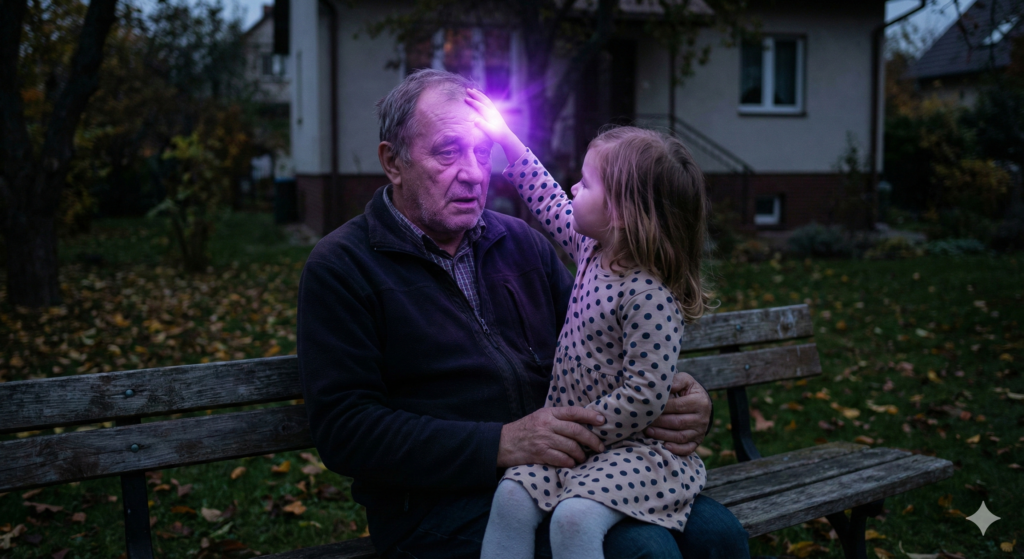
Suddenly, without warning, agile as a cat, she hopped onto his lap. Before he could react, her small, warm hand landed on his forehead—exactly where the intruder lurked under his skull. He felt a violent, sharp tingling, and suddenly the dull, pulsing pain that had accompanied him for weeks vanished like a blown-out candle flame. Only a blissful, cool relief remained. Lili withdrew her hand and frowned, looking at the purple glow around her tiny fingers. “We’ll have to work on that some more,” she remarked critically.
He looked at her, stunned, trying to understand what had just happened. So that was the plan. A great loop of time. Now she heals him and teaches him to see, so that he might survive and repay this debt when she becomes just an ordinary girl, unaware of her power. Two years. A whole two years. The doctors had given him months. She had given him a purpose that transcended death…
#LiliTheMist #TimeLoop #WritingCommunity #ShortStory